

Conversas com Cinema© PROSA
Ciclo
IN THE NAME OF GOD
[IN THE NAME OF GOD Cinema Screenings]
Curadoria de Alexandre Braga
Há talvez poucas palavras que tenham sido pronunciadas com tanta esperança e, simultaneamente, com tanta violência como a palavra Deus.
Ao longo da História, o seu nome serviu para consolar, reunir e dar sentido à experiência humana, mas também para legitimar conquistas, impor comportamentos, silenciar diferenças e justificar atos que dificilmente encontrariam fundamento fora de uma autoridade considerada absoluta. Quando alguém afirma agir em nome de Deus, a palavra deixa de designar apenas uma relação com o transcendente: pode transformar-se num instrumento de poder.
O ciclo IN THE NAME OF GOD parte dessa inquietação através de dois filmes profundamente físicos e violentos, nos quais fé, autoridade, culpa e desejo se confundem. Não se trata de colocar Deus no banco dos réus, mas de observar aquilo que os homens são capazes de fazer quando acreditam, ou afirmam, possuir o direito de falar em Seu nome.
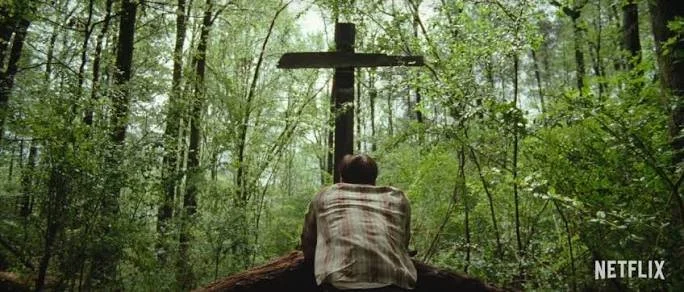
Em THE DEVIL ALL THE TIME (2020), de António Campos, atravessamos uma América rural marcada por gerações de trauma, guerra, pobreza e fervor religioso. Pregadores, pais e figuras de autoridade invocam constantemente a fé enquanto a violência se infiltra nas relações familiares e comunitárias. Nesse universo, a religião tanto pode nascer do desespero humano perante a morte como converter-se numa linguagem de manipulação, abuso e justificação do intolerável. No centro desse mundo encontra-se Arvin, um jovem que herda a violência sem herdar inteiramente a crença e que terá de descobrir se é possível escapar ao círculo moral construído pelos que vieram antes dele.
Em GODLAND (2022), de Hlynur Pálmason, a questão desloca-se para o final do século XIX. Lucas, um jovem padre dinamarquês, atravessa a paisagem brutal da Islândia com a missão de construir uma igreja e levar consigo a palavra de Deus. Mas quanto mais procura inscrever a sua fé, a sua língua e a sua autoridade naquele território, mais a própria paisagem parece resistir-lhe. A missão religiosa mistura-se então com outra forma de poder: a de uma Dinamarca que procura ordenar cultural e espiritualmente uma terra que domina politicamente. Pouco a pouco, a certeza do missionário transforma-se em arrogância, isolamento e violência.
Separados por mais de um século nas suas narrativas, os dois filmes encontram-se numa mesma pergunta: o que acontece quando a convicção de possuir a verdade dispensa a necessidade de compreender o outro? Talvez pertença ao passado a época em que determinadas formas de autoridade religiosa podiam apresentar-se de maneira tão frontal e incontestada. Mas seria ingénuo pensar que desapareceu o mecanismo que estes filmes expõem. Ele permanece onde quer que uma verdade absoluta seja utilizada para suspender a dúvida, legitimar o poder ou transformar o outro em alguém que deve ser convertido, corrigido, submetido ou eliminado.
IN THE NAME OF GOD propõe, por isso, uma reflexão menos sobre a fé do que sobre a sua instrumentalização. Talvez Deus não esteja necessariamente na voz daquele que O proclama mais alto, nem na certeza daquele que afirma conhecer a Sua vontade. Talvez possa estar precisamente no lugar oposto: nas pequenas coisas, na atenção silenciosa ao outro, na fragilidade, no cuidado, na capacidade de reconhecer aquilo que não compreendemos. E talvez esteja também na própria dúvida — não como ausência de fé, mas como consciência humana de que nenhuma palavra consegue apropriar-se inteiramente daquilo que pretende nomear.
Porque entre procurar Deus e falar em nome de Deus existe uma distância fundamental. A primeira experiência pode obrigar-nos a permanecer diante do mistério, aceitando a dúvida e a alteridade; a segunda pode conceder-nos a perigosa certeza de já possuir a resposta. Talvez seja justamente nessa distância — entre a humildade de procurar e a violência de afirmar — que estes dois filmes nos convidam a permanecer.
(Curadoria de Alexandre Braga)
_ENG
There are perhaps few words that have been spoken with as much hope — and, at the same time, with as much violence — as the word God.
Throughout history, His name has been invoked to comfort, to bring people together and to give meaning to human experience, but also to legitimise conquest, impose behaviour, silence difference and justify acts that would otherwise struggle to find any moral foundation outside an authority considered absolute. When someone claims to act in the name of God, the word ceases to describe only a relationship with the transcendent: it can become an instrument of power.
The IN THE NAME OF GOD cycle begins with this unease, bringing together two deeply physical and violent films in which faith, authority, guilt and desire become entangled. The intention is not to put God on trial, but to observe what human beings are capable of doing when they believe — or claim — that they have the right to speak in His name.
In THE DEVIL ALL THE TIME (2020), by António Campos, we enter a rural America marked by generations of trauma, war, poverty and religious fervour. Preachers, fathers and figures of authority repeatedly invoke faith while violence permeates family and community life. In this world, religion can emerge from human despair in the face of death, but it can also become a language of manipulation, abuse and justification for the intolerable. At the centre of it all is Arvin, a young man who inherits violence without entirely inheriting belief, and who must discover whether it is possible to escape the moral cycle constructed by those who came before him.
In GODLAND (2022), by Hlynur Pálmason, the question shifts to the late nineteenth century. Lucas, a young Danish priest, crosses the brutal Icelandic landscape with a mission to build a church and carry the word of God into a remote territory. Yet the more he attempts to inscribe his faith, his language and his authority upon that land, the more the landscape itself seems to resist him. His religious mission gradually becomes entangled with another form of power: that of a Denmark seeking to impose cultural and spiritual order upon a land it politically controls. Little by little, the missionary’s certainty gives way to arrogance, isolation and violence.
Although their stories are separated by more than a century, the two films converge upon the same question: what happens when the conviction that one possesses the truth removes the need to understand the other. Perhaps the age in which certain forms of religious authority could present themselves so openly and unquestioningly belongs to the past. But it would be naïve to believe that the mechanism exposed by these films has disappeared. It remains wherever an absolute truth is used to suspend doubt, legitimise power, or transform the other into someone who must be converted, corrected, subdued or eliminated.
IN THE NAME OF GOD therefore proposes a reflection less on faith itself than on its instrumentalisation. Perhaps God is not necessarily to be found in the voice of those who proclaim Him the loudest, nor in the certainty of those who claim to know His will. Perhaps He may be found precisely in the opposite place: in small things, in silent attention to the other, in vulnerability, in care, in our capacity to acknowledge what we do not understand. And perhaps He may also be found in doubt itself — not as the absence of faith, but as the human awareness that no word can ever fully possess that which it seeks to name.
For there is a fundamental distance between seeking God and speaking in the name of God. The first may require us to remain before the mystery, accepting doubt and otherness; the second may grant us the dangerous certainty that we already possess the answer. Perhaps it is precisely within that distance — between the humility of seeking and the violence of asserting — that these two films invite us to remain.
(Curatorship by Alexandre Braga)
“THE DEVIL ALL THE TIME” 2020 | M/12 | 1h22’ [US] (O Diabo, sempre - PT)
De António Campos
Sexta Dia 09/10 às 19h30 [Friday 10/09 at 7:30pm]
Num meio rural entre o Ohio e a Virgínia Ocidental, um ciclo de trauma geracional e fanatismo religioso atravessa várias vidas. Enquanto enfrenta o legado violento do pai e a corrupção moral de figuras de autoridade da comunidade, um jovem procura encontrar o seu próprio caminho.
A cycle of generational trauma and religious fanaticism consumes rural Ohio and West Virginia, as a young man confronts the violent legacy of his father and the predatory sins of local authority figures.
Spoken in English | Subtitled in Portuguese
“GODLAND” 2022 | M/16 | 1h53’ [IS/DK/FR/SE] (Terra de Deus - PT)
De Hlynur Pálmason
Sábado Dia 10/10 às 19h30 [Saturday 10/10 at 7:30pm]
No final do século XIX, um jovem padre dinamarquês é enviado para uma região remota da Islândia. À medida que se aventura cada vez mais profundamente na paisagem islandesa, começa a perder o sentido da realidade, da sua missão e da própria fé que o guiava.
At the end of the 19th century, a young Danish priest is sent to a remote part of Iceland. The deeper he travels into the Icelandic landscape, the more he loses a sense of his own reality, his mission and his sense of duty.
Spoken in Danish | Subtitled in English
Todos os filmes do Cinema PROSA serão exibidos em pixel iluminado (ecrã QLED 65’’) em sala condicionada ao máximo de 24 espectadores.
Preçário
Membros: Entrada livre.
Não-membros: Donativo sugerido de 3€
All Cinema PROSA films will be shown on an illuminated pixel (65’’ QLED screen) in a room with a maximum capacity of 24 spectators.
Prices
Members: Free Entry.
Non-members: Suggested donation of 3€.
Trailers: