

Conversas com Cinema© PROSA
Ciclo
DAVID BOWIE:
METAMORFOSE E VERTIGEM
[DAVID BOWIE: METHAMORFOSIS AND VERTIGO
Cinema Screenings]
Há artistas cuja presença no cinema não se limita à atuação. Tornam-se forças de deslocamento. Cada gesto, cada olhar, cada silêncio transporta consigo um campo de energia que altera o equilíbrio da própria imagem. David Bowie foi um desses raros casos: figura de metamorfose permanente, capaz de atravessar a música, o teatro, a performance e o cinema como quem habita múltiplas identidades ao mesmo tempo.
Mais do que um ator ocasional, Bowie trouxe para o ecrã uma qualidade particular de vertigem. As suas personagens parecem sempre situar-se num limiar: entre culturas, entre épocas, entre o humano e o enigma. O cinema, nesse encontro, torna-se espaço de instabilidade produtiva — um lugar onde o rosto do intérprete nunca se fixa completamente numa única identidade.
Este ciclo propõe revisitar duas obras muito distintas, mas atravessadas por essa mesma energia de deslocamento.
Em Merry Christmas, Mr. Lawrence (1983), de Nagisa Oshima, Bowie interpreta o Major Jack Celliers, um prisioneiro britânico num campo japonês durante a Segunda Guerra Mundial. O filme constrói um território delicado de tensões entre honra, desejo, disciplina e alteridade cultural. Mais do que um drama de guerra, é um estudo sobre o confronto entre códigos morais incompatíveis — onde a presença magnética de Bowie introduz uma dimensão quase mítica. A personagem torna-se uma espécie de corpo estranho dentro da ordem militar, perturbando silenciosamente as hierarquias do poder e da obediência.
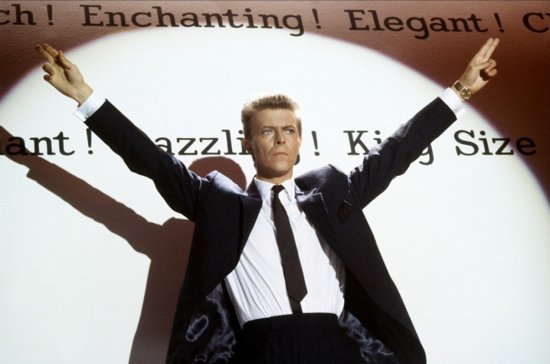
Três anos depois, surge Absolute Beginners (1986), de Julien Temple — um filme radicalmente diferente. Aqui, Bowie aparece como figura icónica no coração de um musical vibrante situado no Soho londrino de 1958, no momento em que a juventude, a música e a cultura pop começam a redesenhar o imaginário urbano britânico. Entre jazz, fotografia, publicidade e rebeldia juvenil, o filme captura o instante em que uma nova sensibilidade estética e política começa a emergir.
Se o filme de Oshima trabalha a vertigem do encontro entre civilizações, o de Temple mergulha na vertigem da modernidade cultural. Num caso, a metamorfose acontece no confronto entre códigos éticos; no outro, no nascimento de novas linguagens visuais e musicais.
Entre guerra e juventude, entre silêncio e espetáculo, estas duas obras revelam algo essencial sobre Bowie: a sua capacidade de existir no cinema como figura liminar — alguém que nunca pertence totalmente ao mundo que habita, mas que, precisamente por isso, o ilumina de maneira inesperada.
(Curadoria de Alexandre Braga)
_ENG
There are artists whose presence in cinema goes far beyond acting. They become forces of displacement. Every gesture, every glance, every silence carries an energy capable of altering the balance of the image itself. David Bowie was one of those rare figures: an artist of perpetual metamorphosis, able to move through music, theatre, performance and cinema as if inhabiting several identities at once.
More than an occasional actor, Bowie brought to the screen a distinctive sense of vertigo. His characters often seem to exist on a threshold — between cultures, between eras, between the human and the enigmatic. In that encounter, cinema becomes a space of productive instability: a place where the performer’s face never fully settles into a single identity.
This cycle revisits two very different films, both animated by that same energy of displacement.
In Merry Christmas, Mr. Lawrence (1983), directed by Nagisa Oshima, Bowie plays Major Jack Celliers, a British prisoner in a Japanese camp during the Second World War. The film constructs a delicate territory of tensions between honour, desire, discipline and cultural alterity. More than a war drama, it is a study of the confrontation between incompatible moral codes — where Bowie’s magnetic presence introduces an almost mythical dimension. His character becomes a kind of foreign body within the military order, quietly disturbing the hierarchies of power and obedience.
Three years later comes Absolute Beginners (1986), directed by Julien Temple — a radically different film. Here Bowie appears as an iconic presence within a vibrant musical set in London’s Soho in 1958, at the moment when youth culture, music and pop aesthetics began reshaping the British urban imagination. Between jazz, photography, advertising and youthful rebellion, the film captures the instant when a new visual and cultural sensibility begins to emerge.
If Oshima’s film explores the vertigo of encounters between civilizations, Temple’s plunges into the vertigo of cultural modernity. In one case, metamorphosis arises from the clash of ethical codes; in the other, from the birth of new visual and musical languages.
Between war and youth, between silence and spectacle, these two works reveal something essential about Bowie: his ability to exist in cinema as a liminal figure — someone who never fully belongs to the world he inhabits, yet precisely for that reason illuminates it in unexpected ways.
(Curatorship by Alexandre Braga)
“MERRY CHRISTMAS, MR. LAWRENCE” 1983 | M/16 | 2h03’ [UK / JP / NZ] (Feliz Natal, Mr. Lawrence - PT)
De Nagisa Oshima
Sexta Dia 10/04 às 19h30 [Friday 04/09 at 7:30pm]
Num campo de prisioneiros japonês durante a Segunda Guerra Mundial, um oficial britânico e um comandante japonês desenvolvem uma relação complexa marcada por códigos de honra, choque cultural e desejo reprimido. Entre disciplina militar e humanidade frágil, o filme explora a tensão entre poder, culpa e compaixão.
In a Japanese POW camp during World War II, a British officer and a Japanese commander develop a complex relationship shaped by honor, cultural clash, and suppressed desire. Between military discipline and fragile humanity, the film explores power, guilt, and compassion.
Spoken in Japanese/English | Subtitled in English
“ABSOLUTE BEGINNERS” 1986 | M/14 | 1h48’ [UK]
De Julien Temple
Sábado Dia 11/04 às 19h30 [Saturday 04/11 at 7:30pm]
Na Londres vibrante do final dos anos 1950, um jovem fotógrafo e os seus amigos atravessam um mundo de música, moda e mudanças sociais. Entre romance, ambição e tensões raciais, o filme retrata o nascimento da cultura juvenil moderna.
In the vibrant London of the late 1950s, a young photographer and his friends navigate a world of music, fashion, and social change. Amid romance, ambition, and racial tensions, the film captures the birth of modern youth culture.
Spoken in English | Subtitled in Portuguese
Todos os filmes do Cinema PROSA serão exibidos em pixel iluminado (ecrã QLED 65’’) em sala condicionada ao máximo de 24 espectadores.
Preçário
Membros: Entrada livre.
Não-membros: Donativo sugerido de 3€
All Cinema PROSA films will be shown on an illuminated pixel (65’’ QLED screen) in a room with a maximum capacity of 24 spectators.
Prices
Members: Free Entry.
Non-members: Suggested donation of 3€.
Trailers: