

Conversas com Cinema© PROSA
Ciclo
NA VIRTUDE E NO EXCESSO
[ON VIRTUE AND EXCESS Cinema Screenings]
O ciclo NA VIRTUDE E NO EXCESSO propõe um gesto simples e delicado: pensar o torpor não como tema moral, mas como dispositivo narrativo e existencial. Não se trata de apologia nem de condenação. Trata-se de observar como formas suaves de alienação — quotidianas, socialmente toleradas — podem tanto suspender o peso do mundo como precipitar o colapso do desejo de sair dele.
Mas por que esta necessidade atravessa as comunidades humanas desde os seus primórdios?
E o que acontece a esse gesto mínimo num presente marcado pela aceleração contínua, pela produtividade excessiva e pela exigência permanente de performance? Quando o corpo já não pode parar, quando o desejo é continuamente capturado, será o torpor uma pausa — ou apenas mais uma forma de adaptação química a um sistema que nunca suspende?
Será ainda ritual, pertença, comunidade — ou apenas sintoma discreto de uma saúde social em risco?
Em Leaving Las Vegas (1995), o álcool não é excesso festivo nem fuga momentânea: é programa de extinção. Ben Sanderson chega a Las Vegas não para se perder, mas para cumprir um pacto consigo mesmo — beber até ao fim. O gesto é radical e desesperado, mas também lúcido: não há ilusão de redenção. No entanto, a entrada de Sera desestabiliza essa lógica absoluta. A relação entre os dois não cura, não salva, não moraliza — revela. A fraqueza deixa de ser apenas queda individual e torna-se superfície de espelhamento: dois corpos feridos que reconhecem, um no outro, a impossibilidade de correção. Aqui, o excesso não liberta nem destrói apenas: expõe.
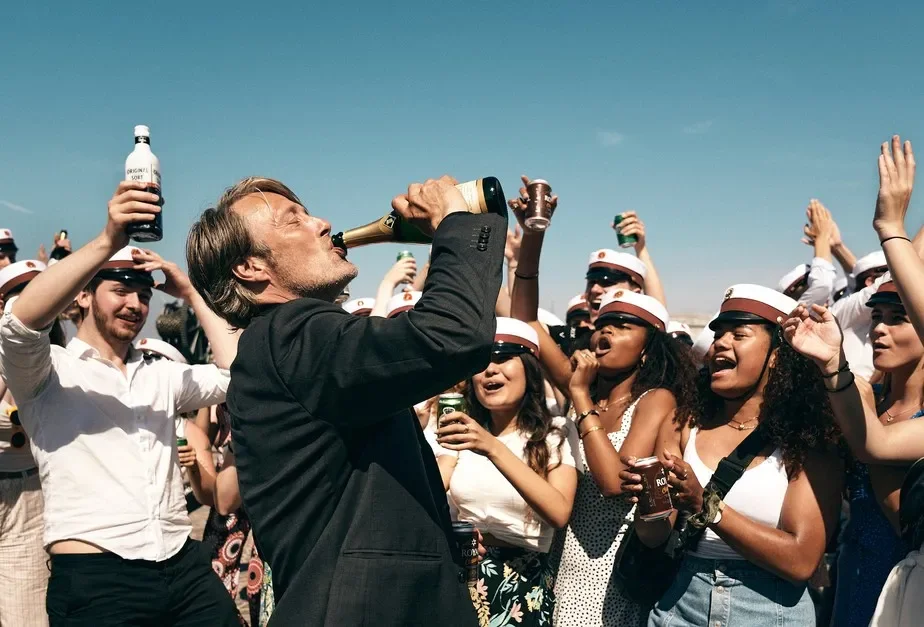
Já em Druk (2020), o álcool surge como metodologia experimental. Inspirado nas reflexões do psiquiatra dinamarquês Finn Skårderud, o filme parte da premissa provocadora de que o ser humano nasce com um défice alcoólico mínimo — e que corrigi-lo poderia reequilibrar a relação com o mundo. Não se trata de eficiência, mas de relativização: do eu, do medo, da rigidez social. O álcool funciona como uma chave provisória para a presença. Contudo, a experiência carrega desde o início o seu perigo interno: a linha entre uso e abuso é ténue, instável, sempre prestes a ser atravessada. O que começa como gesto de cuidado de si pode transformar-se, sem aviso, em nova forma de captura.
Colocados em diálogo, os dois filmes desenham um arco subtil: num, o álcool como decisão terminal, no outro, como ensaio de vida. Mas ambos recusam a moral fácil. Ambos revelam que a virtude não está na abstinência nem o excesso na substância, mas na relação que se estabelece com ela — relação com o corpo, com o tempo, com o outro, com a própria fragilidade.
É um ciclo sobre limites: sobre quando o gesto deixa de ser abertura e se torna clausura; sobre quando a suspensão do mundo permite respirar — e quando já não permite regressar.
(Curadoria de Alexandre Braga)
_ENG
ON VIRTUE AND EXCESS proposes a simple and delicate gesture: to think torpor not as a moral theme, but as a narrative and existential device. This is neither an apology nor a condemnation. It is an attempt to observe how gentle forms of alienation—everyday, socially tolerated—can both suspend the weight of the world and precipitate the collapse of the desire to exit it.
But why has this need traversed human communities since their beginnings?
And what becomes of this minimal gesture in a present marked by continuous acceleration, excessive productivity, and the permanent demand for performance? When the body can no longer stop, when desire is continuously captured, is torpor a pause—or merely another form of chemical adaptation to a system that never suspends?
Is it still ritual, belonging, community—or only a discreet symptom of a social health at risk?
In Leaving Las Vegas (1995), alcohol is neither festive excess nor momentary escape: it is a program of extinction. Ben Sanderson arrives in Las Vegas not to lose himself, but to fulfill a pact with himself—to drink to the end. The gesture is radical and desperate, yet also lucid: there is no illusion of redemption. However, Sera’s arrival destabilizes this absolute logic. The relationship between them does not heal, does not save, does not moralize—it reveals. Weakness ceases to be merely an individual fall and becomes a surface of mirroring: two wounded bodies recognizing, in one another, the impossibility of correction. Here, excess neither liberates nor simply destroys—it exposes.
In Druk (2020), alcohol appears as an experimental methodology. Inspired by the reflections of Danish psychiatrist Finn Skårderud, the film departs from the provocative premise that the human being is born with a minimal alcohol deficit—and that correcting it might rebalance one’s relation to the world. This is not about efficiency, but relativization: of the self, of fear, of social rigidity. Alcohol functions as a provisional key to presence. Yet the experiment carries its danger from the outset: the line between use and abuse is thin, unstable, always on the verge of being crossed. What begins as a gesture of care of the self can, without warning, turn into a new form of capture.
Placed in dialogue, the two films trace a subtle arc: in one, alcohol as a terminal decision; in the other, as a rehearsal for life. Yet both refuse easy morality. Both reveal that virtue does not lie in abstinence, nor excess in the substance itself, but in the relation established with it—the relation with the body, with time, with the other, with one’s own fragility.
It is a cycle about limits: about when a gesture ceases to be an opening and becomes a closure; about when the suspension of the world allows us to breathe—and when it no longer allows a return.
(Curatorship by Alexandre Braga)
“LEAVING LAS VEGAS” 1995 | M/18 | 1h51’ [US] (Morrer em Las Vegas - PT)
De Mike Figgis
Sexta Dia 23/01 às 19h30 [Friday 01/23 at 7:30pm]
Ben Sanderson, um roteirista de Hollywood que perdeu tudo por causa de seu alcoolismo, chega a Las Vegas para beber até a morte.
Lá ele conhece Sera, uma garota da rua.
Ben Sanderson, a Hollywood screenwriter who has lost everything because of his alcoholism, arrives in Las Vegas to drink himself to death. There he meets Sera, a street girl.
Spoken in English | Subtitled in Portuguese
“DRUK” 2020 | M/16 | 1h57’ [DK/SE/NL] (Another Round - ENG | Mais uma Rodada - PT)
De Thomas Vinterberg
Sábado Dia 24/01 às 19h30 [Saturday 01/24 at 7:30pm]
Quatro amigos, todos professores do ensino médio, testam a teoria de que melhorarão suas vidas mantendo um nível constante de álcool no sangue.
Four friends, all high-school teachers, test the theory that they will improve their lives by maintaining a constant level of alcohol in their blood.
Spoken in Danish | Subtitled in English
Todos os filmes do Cinema PROSA serão exibidos em pixel iluminado (ecrã QLED 65’’) em sala condicionada ao máximo de 24 espectadores.
Preçário
Membros: Entrada livre.
Não-membros: Donativo sugerido de 3€
All Cinema PROSA films will be shown on an illuminated pixel (65’’ QLED screen) in a room with a maximum capacity of 24 spectators.
Prices
Members: Free Entry.
Non-members: Suggested donation of 3€.
Trailers: