

Conversas com Cinema© PROSA
Ciclo
VIDAS SUBMERSAS
[SUBMERGED LIVES Cinema Screenings]
VIDAS SUBMERSAS nasce de uma inquietação antiga: a pergunta silenciosa que permanece quando o progresso técnico avança sobre a memória viva. O que acontece quando a promessa de energia, desenvolvimento e futuro exige, como contrapartida, o apagamento de séculos de convivência, de rituais mínimos, de uma geografia afectiva que não se deixa traduzir em megawatts?
A história recente está marcada por estas submersões forçadas. Em Portugal, a Aldeia da Luz, no Alentejo, e Vilarinho de Furnas, no Norte, tornaram-se símbolos de uma modernidade que desloca corpos e casas, mas também temporalidades, vínculos e modos de estar no mundo. O caso do Foz Côa — interrompido pela descoberta das gravuras rupestres paleolíticas — lembra-nos, de forma quase trágica, que nem todas as perdas são aceitáveis, e que há imagens que resistem ao afogamento do tempo.
Em Adeus a Matiora (1983), de Elem Klimov, essa violência surge envolta num lirismo austero e profundamente ritual. Matiora não é apenas uma aldeia condenada: é um organismo espiritual que assiste à própria extinção. A velha mulher que se esconde na ruína da árvore, os gestos repetidos, os estados de torpor colectivo — tudo aponta para uma tentativa desesperada de metabolizar o impensável. O filme não dramatiza o conflito; observa-o como quem acompanha um funeral prolongado, onde a aceitação não é consenso, mas fadiga.
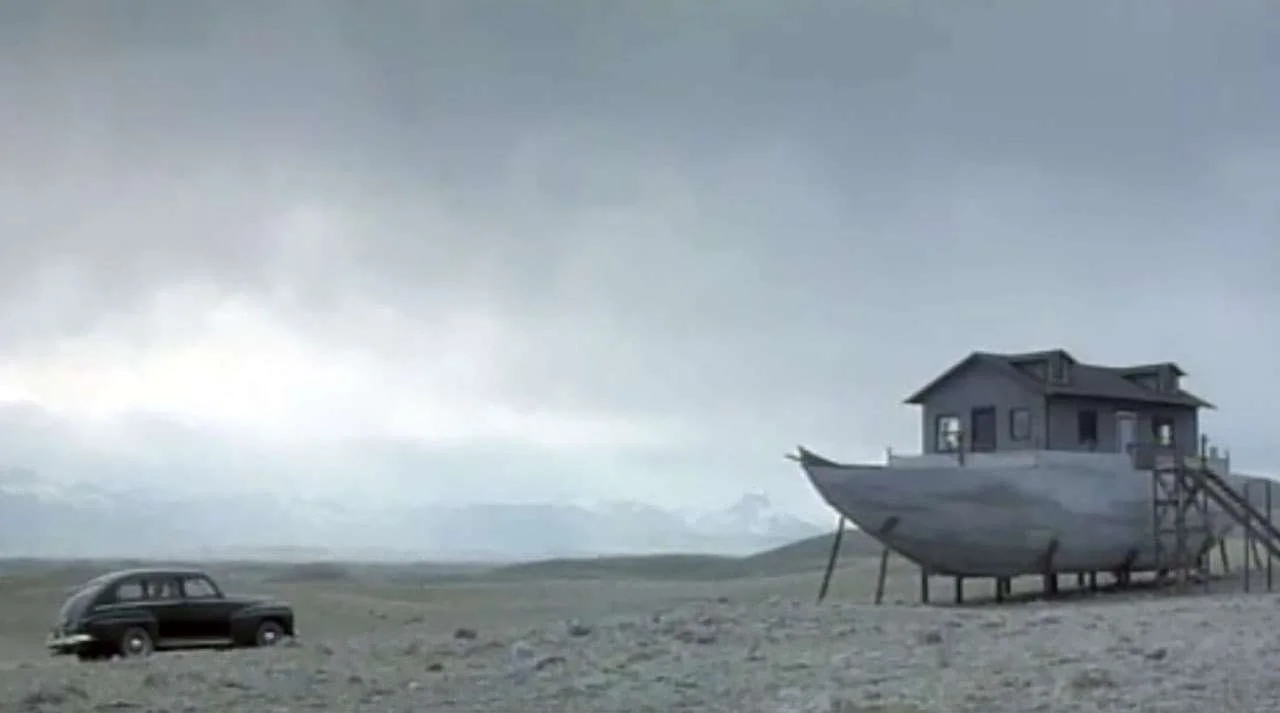
Já Northfork (2003), de Michael Polish, desloca esta experiência para a América rural dos anos 50. Aqui, a submersão é filtrada por uma estética quase etérea, próxima do sonho e da fábula. A pequena comunidade do Montana vive a expulsão como se estivesse suspensa entre dois mundos: o que se desfaz e o que nunca chega verdadeiramente. É um filme de beleza formal delicada, onde a violência do progresso se manifesta menos pelo choque e mais pela melancolia de um adeus sem retorno.
Este gesto cinematográfico encontra eco noutras geografias e linguagens. Em Still Life (2006), Jia Zhangke filma as demolições provocadas pela Barragem das Três Gargantas como um quotidiano em dissolução lenta, onde as ruínas convivem com o absurdo e o banal. Já a artista Chen Qiulin transforma a deslocação da sua cidade natal em obra activista, costurando memória, corpo e perda num gesto que é simultaneamente íntimo e político.
VIDAS SUBMERSAS propõe, assim, um espaço de escuta e contemplação. Não se trata de condenar o progresso nem de romantizar o passado, mas de reconhecer o custo invisível destas decisões. Cada aldeia submersa é também uma narrativa interrompida, um ritual quebrado, uma forma de vida que não encontra tradução no discurso técnico. O cinema, aqui, torna-se lugar de resistência: uma última margem onde essas vidas continuam — não à tona da água, mas à superfície da memória.
(Curadoria de Alexandre Braga)
_ENG
SUBMERGED LIVES is born from a long-standing unease: the silent question that remains when technical progress advances over living memory. What happens when the promise of energy, development, and future demands— as its counterpart—the erasure of centuries of coexistence, of minimal rituals, of an affective geography that cannot be translated into megawatts?
Recent history is marked by these forced submersions. In Portugal, the village of Luz, in Alentejo, and Vilarinho de Furnas, in the North, became symbols of a modernity that displaces not only bodies and houses, but also temporalities, bonds, and ways of inhabiting the world. The case of Foz Côa—halted by the discovery of Paleolithic rock engravings—reminds us, almost tragically, that not all losses are acceptable, and that some images resist being drowned by time.
In Farewell (1983), by Elem Klimov, this violence is enveloped in an austere, deeply ritualistic lyricism. Matyora is not merely a doomed village: it is a spiritual organism witnessing its own extinction. The old woman hiding among the ruins of the tree, the repeated gestures, the collective states of torpor—all point to a desperate attempt to metabolize the unthinkable. The film does not dramatize the conflict; it observes it as one would attend a prolonged funeral, where acceptance is not consensus but exhaustion.
Northfork (2003), by Michael Polish, transposes this experience to rural America in the 1950s. Here, submersion is filtered through an almost ethereal aesthetic, close to dream and fable. The small Montana community lives its expulsion as if suspended between two worlds: the one that dissolves and the one that never truly arrives. It is a film of delicate formal beauty, where the violence of progress manifests less through shock than through the melancholy of an irreversible farewell.
This cinematic gesture resonates across other geographies and languages. In Still Life (2006), Jia Zhangke films the demolitions caused by the Three Gorges Dam as a daily life in slow dissolution, where ruins coexist with the absurd and the banal. The activist work of Chen Qiulin, meanwhile, transforms the displacement of her hometown into a practice that stitches together memory, body, and loss—an intimate gesture that is also profoundly political.
SUBMERGED LIVES thus proposes a space of listening and contemplation. It is not about condemning progress nor romanticizing the past, but about acknowledging the invisible cost of these decisions. Each submerged village is also an interrupted narrative, a broken ritual, a form of life that finds no translation in technical discourse. Cinema becomes, here, a site of resistance: a final shore where these lives continue—not on the surface of the water, but on the surface of memory.
(Curatorship by Alexandre Braga)
“PROSHCHANIE” 1983 | M/12 | 2h01’ [URSS] (Farewell - ENG | Adeus a Matiora - PT)
De Elem Klimov
Sexta Dia 27/02 às 19h30 [Friday 02/27 at 7:30pm]
Matyora é uma pequena aldeia situada numa bela ilha com o mesmo nome. A existência da aldeia é ameaçada pela construção de uma barragem que a deixará submersa. Esta é a história dos habitantes de Matyora e da sua despedida da terra natal.
Matyora is a small village on a beautiful island with the same name. The existence of the village is threatened with flooding by the construction of a dam. This is the story of the inhabitants of Matyora and their farewell to their homeland.
Spoken in Russian | Subtitled in English
“NORTHFORK” 2003 | M/12 | 1h43’ [US]
De Michael Polish
Sábado Dia 28/02 às 19h30 [Saturday 02/28 at 7:30pm]
Passado em 1955, os habitantes de uma pequena comunidade no Montana são obrigados a deslocar as suas casas para
dar lugar a uma nova barragem.
Set in 1955, the residents of a small Montana community are forced to move their homes to make way for a new dam.
Spoken in English | Subtitled in Portuguese
Todos os filmes do Cinema PROSA serão exibidos em pixel iluminado (ecrã QLED 65’’) em sala condicionada ao máximo de 24 espectadores.
Preçário
Membros: Entrada livre.
Não-membros: Donativo sugerido de 3€
All Cinema PROSA films will be shown on an illuminated pixel (65’’ QLED screen) in a room with a maximum capacity of 24 spectators.
Prices
Members: Free Entry.
Non-members: Suggested donation of 3€.
Trailers: